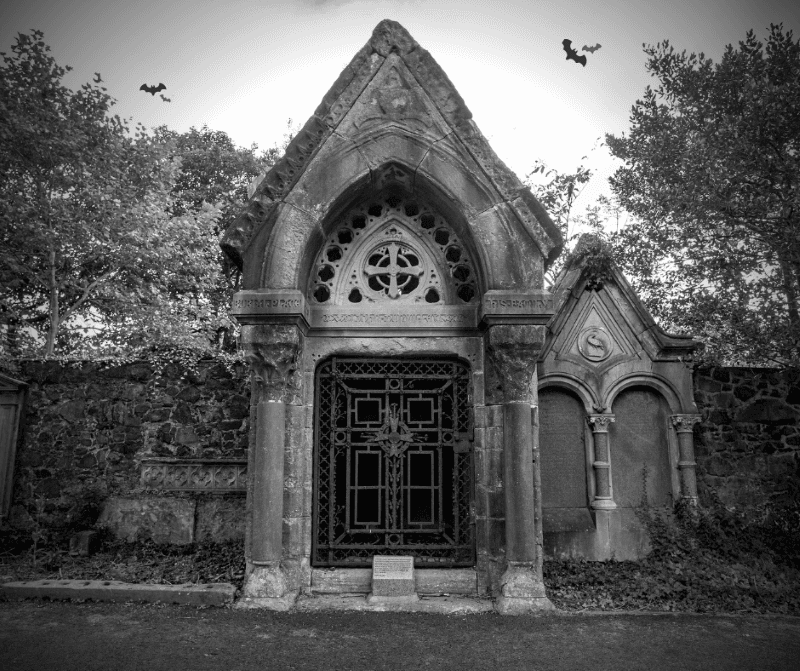
Fancy dress, trick or treating, and dunking for apples are all traditional activities associated with Halloween. But there’s nothing quite like an old cemetery to truly get into the spirit of the spooky season, and here at Belfast Charitable Society, we have one of Belfast’s oldest and most fascinating cemeteries on our doorstep.
Belfast Charitable Society opened its Poor House and infirmary in 1774, providing food, shelter, and medical assistance for scores of men, women, and children, with many more receiving financial and practical support through its outdoor relief scheme. But there came a point when the Society’s committee members realised that whilst caring for the living was essential, the people they helped deserved respect in death too. And so, in 1797, the Society opened a new cemetery on a plot of land behind the Poor House. Initially known as the New Burying Ground, it was to be a cemetery for all citizens of Belfast, from the wealthiest merchants to the poorest vagrants. Those who could afford it would buy a burial plot, those who could not were accommodated in an area known as the poor ground.
Clifton Street Cemetery remained open for business, so to speak, for almost 200 years. An estimated 15,000 people were buried within its walls, and their names and stories provide a fascinating insight into the social history of Belfast. It is the resting place of poets and paupers, doctors and domestic servants, radicals and rag and bone men. Several of the Society’s most high-profile members rest in the grounds, including doctors William Drennan and Robert Stevenson, who pioneered smallpox variolation campaigns from within the Poor House. Mary Ann McCracken, the celebrated social activist and one of Belfast Charitable Society’s most well know figures, lies in the cemetery too. Mary Ann was joined by her brother, the revolutionary Henry Joy, around 1912, more than a century after his death. Henry was originally buried in the old corporation graveyard following his execution for participating in the United Irishmen’s Rebellion of 1798. His bones were exhumed in 1902 and spent a decade on display in the drawing room of a Belfast antiquarian before being finally laid to rest beside his sister, or so the story goes.
Alongside the wealthy, distinguished, and notable names, lie thousands of ordinary people, most of whose life, and indeed death, stories are buried with them. We do know how some met their demise, however, like sisters Jane and Mary McClement who perished together in 1887 as a result of a faulty gas light, and Robert Morrison who was murdered by a Portuguese sailor in 1810. A former black American slave named William John Brown is buried in an unmarked grave on the poor ground plot. After fleeing from his captors, William found himself in Belfast in 1830, where a sympathetic magistrate granted him his freedom. He died within a year, a broken man, but a free one.
The graves in Clifton Street Cemetery tell stories of disease, rebellion, kindness, and conflict. There are tales of bodysnatchers, of debauchery, of vigils, and skirmishes, of scandals, and hangings, and tragedy. And while we can’t say for sure if any ghosts roam the cemetery at nighttime, we do know that little Roseanna Gardner, who died at the age of thirteen in 1840, inspired a ghost story by the Belfast author Martin Waddell.
A short article such as this cannot do justice to the dead who lie in Clifton Street Cemetery. There are too many names on headstones to recount, too many tales to uncover. To discover more, join one of our cemetery tours. Visit our events page to find out when our next one is.